
Professional Solutions for Crack, Pipe, and Skimmer Leaks
PoolMax provides expert pool leak detection in Orange County, utilizing advanced technology to identify and repair structural cracks, underground pipe leaks, and failing skimmers.
Expert Pool Leak Detection in Orange County
Protecting Your Investment with Precise Leak Identification
A leaking pool is more than just a nuisance; it is a threat to the structural integrity of your home and backyard. At PoolMax, we understand that losing even an inch of water a day can lead to massive utility bills and devastating soil erosion beneath your pool deck. Our professional leak detection services are designed to find the “invisible” problems before they turn into catastrophic failures that could compromise your entire landscape.
We don’t just guess where the water is going; we use a systematic approach to isolate the cause of the water loss. By combining years of construction experience with modern diagnostic tools, we can determine if the issue is a simple mechanical fail or a deep structural crack. Our goal is to provide a fast, accurate diagnosis so we can move directly into the necessary repairs and get your pool back to a safe, swim-ready state for your family.
Specialized Repair for Structural Cracks and Underground Pipe Leaks
Advanced Technology to Fix Skimmer and Plumbing Issues
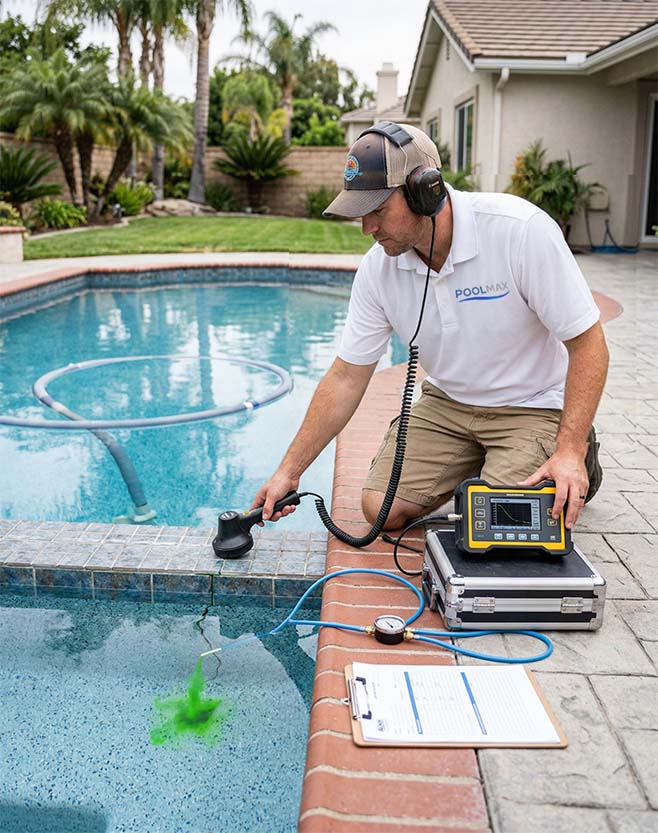
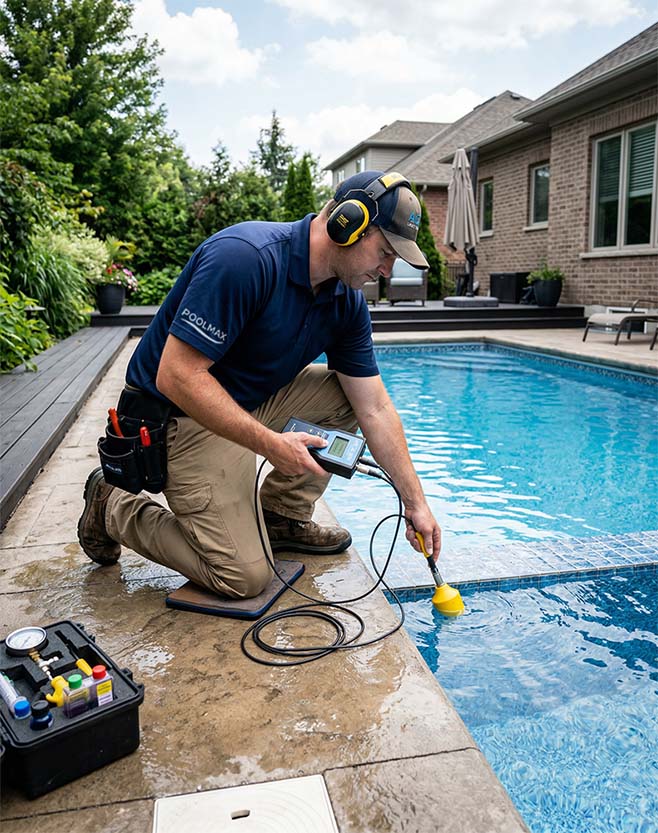
Pool leaks generally fall into three categories: structural, plumbing, or mechanical. Structural crack leaks often occur in the pool shell itself and require specialized masonry and epoxy injections to seal the loss and prevent further shifting. Underground pipe leaks are more elusive, often occurring in the return lines or suction lines due to soil shifting or age. We utilize pressure testing and sonic equipment to pinpoint the exact location of pipe failures without digging up your entire backyard.
One of the most common yet overlooked areas for water loss is the skimmer. Skimmer leaks usually happen where the plastic skimmer throat meets the concrete pool shell, often caused by the two materials expanding and contracting at different rates over time. We perform detailed dye testing to confirm these leaks and use high-grade marine sealants or structural re-bonding to ensure a permanent fix. No matter where the water is escaping, we have the tools and the talent to seal it for good.
do you think your pool may be leaking?
Call us today! Don’t let a leaky pool turn into a disaster
Warning Signs of a Leaking Swimming Pool
Recognizing the early signs of a leak can save you thousands in water bills and structural repairs. If you notice any of the following symptoms in your backyard, it is time to schedule a professional leak detection appointment.
- Excessive Water Loss: Losing more than 1/4 inch of water per day usually indicates a leak rather than simple evaporation.
- Structural Cracks: Visible cracks in the pool shell or the surrounding hardscape are often exit points for escaping water.
- Air in the System: Seeing air bubbles in the pool return lines often means there is a leak in the suction side of your plumbing.
- Soggy Landscape: Unexplained standing water or soggy spots in your yard are major indicators of an underground pipe leak.
- Rising Utility Bills: A sudden spike in your water bill or frequent “auto-fill” activity is a clear sign that your pool is losing water.
Frequently Asked Questions:
A: The bucket test is a simple DIY way to determine if water loss is due to evaporation or a leak. By placing a bucket of water on a pool step and marking the levels inside and out, you can see if the pool level drops faster than the bucket. If it does, you definitely have a leak.
A: In the Southern California climate, it is normal to lose about 1/8 to 1/4 inch of water per day to evaporation, especially during hot, dry, or windy days. Anything beyond that usually indicates a mechanical or structural leak.
A: In most cases, no. We use underwater microphones, dye testing, and electronic sensors to find leaks while the pool is full. We only recommend draining the pool if a major structural repair is required after the leak is located and isolated.
A: Yes. A small leak can wash away the supporting soil under your pool or deck, leading to “sinkholes” or major structural shifting. Fixing a leak early is much cheaper than replacing a collapsed pool deck or a cracked pool shell.