
Gunite vs. Shotcrete:

How Concrete Pool Construction Methods Differ

Gunite vs. Shotcrete: A Pool Builder Explains | PoolMax

If you’ve been getting bids for a concrete pool, you’ve probably had one builder tell you they use gunite and another tell you they use shotcrete — each implying theirs is the better choice.

Here’s the thing almost nobody tells homeowners at that stage:

Gunite is shotcrete.

They aren’t competing products. One is a subset of the other, and the distinction the pool industry draws between them is a decades-old naming habit rather than a meaningful difference in quality. Understanding what’s actually going on will make you a far better judge of the bids on your kitchen table — and it will point you at the questions that genuinely matter, which have very little to do with which word a builder uses.

We’ve been building concrete pools in Orange County for over 30 years. Here’s the honest version.

Gunite & Shotcrete: The Short Answer

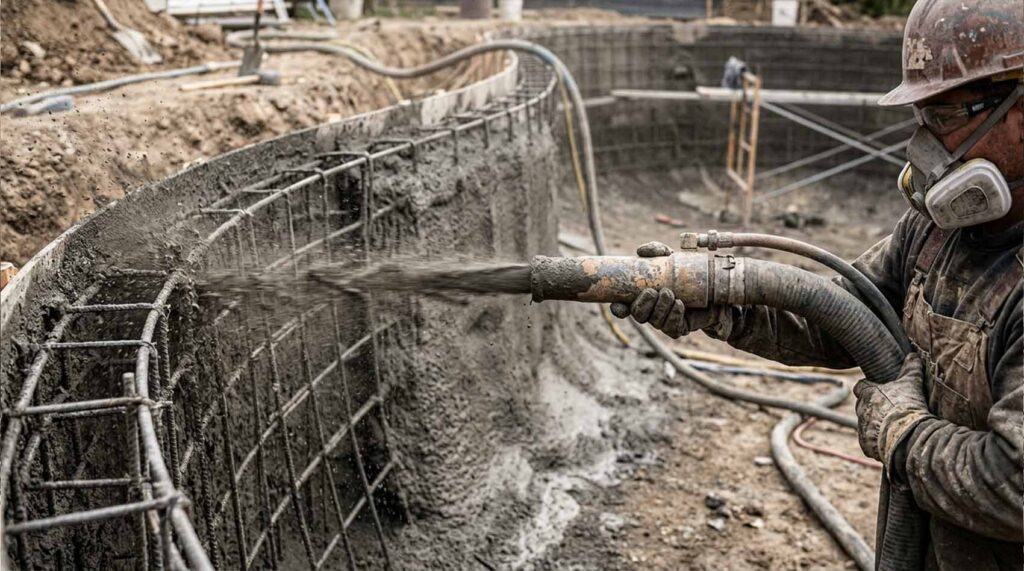
Shotcrete is the umbrella term for concrete that’s pneumatically projected at high velocity through a hose onto a surface. It comes in two forms, defined by how and when the water gets added:

Dry-mix shotcrete — dry cement and aggregate travel through the hose, and water is introduced at the nozzle. In the pool industry, this is what people call “gunite.”

Wet-mix shotcrete — concrete is batched with its water at the plant, delivered ready-mixed, and pumped through the hose, with compressed air added at the nozzle for velocity. In the pool industry, this is what people call “shotcrete.”

Both are shotcrete. Both place structural concrete. Both, applied correctly, produce a sound, monolithic pool shell.

The American Concrete Institute’s Guide to Shotcrete (ACI 506R) treats them as two processes within one method — not as two different materials.

Where the Word “Gunite” Came From

The confusion has a traceable origin, and it’s a good one.

The dry-mix process was invented in 1907 by American taxidermist and naturalist Carl Akeley, who developed a “cement gun” to spray plaster onto museum dioramas. The process worked so well on concrete that it was commercialized — and the name Gunite was registered as a trademark for the dry-mix pneumatic application process.

For roughly four decades, dry-mix was the only option. The wet-mix process wasn’t developed until the 1950s.

Meanwhile, the term “shotcrete” was first formally defined by the American Railway Engineers Association in the early 1930s, and by 1951 it had become the accepted generic name for the sprayed concrete process — whether wet or dry.

So the technically correct hierarchy is:

  • Shotcrete (the method)
  • dry-mix shotcrete (historically trademarked as Gunite)
  • wet-mix shotcrete

The pool industry, for historical reasons, kept using “gunite” for dry-mix and adopted “shotcrete” as if it only meant wet-mix. Everyone in the trade knows what everyone means. It just leaves homeowners comparing two bids and assuming they’re comparing two different things.

How Dry-Mix Shotcrete (Gunite) Works

What Happens at the Nozzle

Dry cement and sand are mixed without water and loaded into a hopper. Compressed air conveys the dry material through a hose at high velocity. At the nozzle, the operator introduces water through a separate ring, hydrating the mix in the final fraction of a second before it hits the steel.

That last detail is the whole story of dry-mix: the water-cement ratio is determined by the person holding the nozzle, in real time, continuously.

A skilled nozzleman reads the material as it leaves the nozzle and adjusts constantly. The mix can be run slightly drier for a vertical wall where it needs to stand up without sagging, and slightly wetter where it needs to flow around congested steel. That control is a genuine advantage in experienced hands.

It is also the method’s primary risk. The same control that lets a good operator optimize the mix lets an inexperienced one get it wrong.

Where Dry-Mix Has the Advantage

Stop-and-start capability. Dry material has no clock running. You can pause, move hose, reposition, and resume. Wet-mix is working against the concrete’s setting time from the moment it’s batched.

Smaller, lighter hose. This matters more than it sounds. A dry-mix hose can be run further and snaked through tighter spaces than a wet-mix line.

Access. Dry material can be delivered in bulk bags or a smaller truck. Wet-mix needs a ready-mix truck and a concrete pump with real access to the site.

Steep and vertical work. The drier mix stands up on vertical faces and overhead surfaces with less tendency to sag.

Complex shapes. Benches, steps, tanning ledges, raised walls, spa dams, and tight radii are all easier to build up gradually with a mix you can tune on the fly.

The Trade-Offs

Higher rebound. Rebound is the material that bounces off the surface instead of sticking. Dry-mix produces noticeably more of it than wet-mix. More on why that matters below — it’s a bigger deal than most homeowners realize.

More dust. A dry-mix shoot is a dusty operation. On a tight lot with close neighbors, that’s a real consideration.

Operator dependency. The mix quality rests heavily on nozzleman skill, because nobody at a batch plant verified the water-cement ratio before it arrived.

Higher air requirement. The American Shotcrete Association notes that dry-mix needs substantially more compressor capacity than wet-mix — on the order of double. Undersized equipment produces an under-velocity stream, and velocity is what consolidates the concrete.
Completed rebar cage in a pool excavation before shotcrete application, showing steel spacing and plumbing stubs |

Gunite & Shotcrete Side-by-Side Comparison

Feature Dry-Mix (Gunite) Wet-Mix (Shotcrete)
Water added At the nozzle, by the operator At the batch plant
Mix consistency Operator-controlled, variable Plant-controlled, documented
Rebound Higher Lower
Dust Higher Lower
Placement rate Slower Faster
Working time Essentially unlimited Limited once batched
Hose Smaller, lighter, longer runs Heavier, shorter practical runs
Site access needed Modest Ready-mix truck + pump truck
Vertical / overhead Excellent Good
Complex shapes Excellent Good
Compressor demand Higher Lower
Achievable strength 4,000+ psi 4,000+ psi

Is One Stronger Than the Other?

No — and this is the question we get most often.

The American Shotcrete Association recommends a minimum 28-day compressive strength of 4,000 psi for pool shells, and states plainly that both dry-mix and wet-mix, with proper materials, equipment, and placement, produce quality concrete.

ACI 506R uses the same threshold to define structural shotcrete: a specified compressive strength of 4,000 psi or greater. The standard applies to both processes equally.

Many engineered pools in Orange County are specified above that — 4,500 psi is common, and projects on challenging soil may specify a sulfate-resistant cement type on top of the strength requirement.

The honest summary: a dry-mix shell shot by an excellent crew will outlast a wet-mix shell shot by a careless one, and the reverse is equally true. The delivery method is not the variable that determines whether your pool is still sound in thirty years.

Here’s what is.

What Actually Determines Whether Your Pool Shell Lasts

Engineering and Soil

Before anyone shoots anything, somebody has to decide how thick the shell is, how much steel goes in it, and how it’s supported.

That decision comes from a geotechnical report on your lot. Orange County’s ground varies enormously over short distances — expansive clay across much of the inland county, groundwater within ten feet of the surface in parts of Fountain Valley and Huntington Beach, engineered hillside pads in Yorba Linda and the North Tustin foothills, slope conditions that require caissons and grade beams in Newport Coast.

A shell engineered for one of those conditions and built on another is the real failure mode. The nozzle is downstream of this.

Steel Placement and Encasement

The reinforcing steel carries the tensile loads. The concrete’s job is to encase it completely.

ACI 506R has a specific term for what goes wrong here: shadow — the area behind an obstacle that the shotcrete stream doesn’t reach and compact. A void behind a rebar bar is a shadow, and it’s exactly where water finds its way to steel.

Preventing it is technique: the nozzleman has to shoot at the correct angle and distance, encase bars from the side rather than burying them head-on, and keep the stream velocity high enough to consolidate the material around every bar. This applies identically to both processes.

Rebound — and Why It Has to Be Removed

Rebound is material that bounces off rather than sticking. It’s unavoidable, and it’s more significant in dry-mix.

The critical point: rebound that has bounced off has lost cement, and it must be removed from the shell — never troweled back in.

Rebound worked back into the surface creates zones that are under-cemented, poorly consolidated, and weak. It looks fine on shoot day. It’s a defect you’ve paid for and can’t see.

This is a genuine quality differentiator between crews, and it’s invisible to a homeowner standing in the driveway. It’s worth asking about.

Pool Shell Curing

This is where more pool shells are compromised than in any other step, and it has nothing to do with gunite versus shotcrete.

Concrete doesn’t dry — it cures, through a chemical reaction that needs water. A shell that’s allowed to dry out in Southern California sun during its first week doesn’t reach its design strength, full stop.

Industry guidance calls for keeping the shell continuously moist for a minimum of seven days. In practice that means hosing it down several times a day, every day, including weekends.

It costs almost nothing and it’s skipped constantly, because nobody is watching and the consequences don’t show up for years. Ask any builder what their curing protocol is and who is responsible for it. The answer tells you a great deal about the company.

Why Site Access Often Decides the Method in Orange County

Here’s something you won’t read on a national pool site: in much of our service area, the choice is made for you by the driveway.

Wet-mix shotcrete requires a ready-mix truck and a concrete pump truck with a workable staging position. On a 35-by-85-foot lot in Old Town Seal Beach, a Balboa Island parcel with alley-only access, or a narrow Huntington Beach Peninsula lot, that may be physically impossible.

Dry-mix’s smaller, lighter hose can be run further and through tighter spaces, and the dry material can arrive in a smaller vehicle. On genuinely constrained sites it is frequently the only practical option — which is one reason experienced builders in coastal Orange County stay fluent in both.

Conversely, on a large Villa Park or Yorba Linda lot with good truck access and a big pour, wet-mix’s output advantage is real.

If a builder tells you they only ever use one method, ask what they do when the site doesn’t suit it.

What Orange County Permitting Requires

Concrete pools in Orange County are engineered structures, and the permitting reflects that.

Your plans go through structural plan check, and on engineered pools the building department commonly requires special inspection of the shotcrete — covering the design mix, placement, curing temperature, and strength verification. That means an independent, qualified inspector present during the shoot, documenting that what was specified is what got installed.

Requirements vary by jurisdiction. Our city resource pages cover the building department contacts and permit process for each city we work in, so you can confirm what applies to your address.

Questions to Ask Any Pool Builder Before You Sign

Skip “do you use gunite or shotcrete?” Ask these instead.

1. What compressive strength is specified for my shell, and how is it verified?
You want a number, and you want to know whether test panels or cylinders are being taken.

2. Is your nozzleman ACI-certified, and in which process?
The American Concrete Institute runs a Shotcreter (nozzleman) certification program, administered largely through the American Shotcrete Association. Certification is issued separately for dry-mix and wet-mix, requires documented field hours plus written and performance testing, and is valid for five years. This is the most meaningful single credential in the entire shotcrete process — and most homeowners have never heard of it.

3. How do you handle rebound?
You’re listening for “we remove it.” If you hear anything about working it back into the shell, keep interviewing.

4. What’s your curing protocol, and who’s responsible for it?
Seven days minimum, kept continuously moist. Ask who does it and what happens on Sunday.

5. Which method are you using on my site, and why that one?
A good builder will talk about your access, your lot, and your design. A weak answer is “it’s what we always do.”

6. Will my project require special inspection, and is it in your estimate?
It’s a real cost. It should be a line item, not a surprise.

7. Can I see the geotechnical report and what it means for my shell?
Every properly built pool starts here.

How PoolMax Approaches It

We build with both processes, and we choose based on the site rather than on habit.

On tight coastal lots where a pump truck can’t stage, dry-mix is often the only way to get a quality shell in the ground. On large lots with good access and significant volume, wet-mix’s consistency and output make it the better call. On complex designs with raised walls, benches, spa dams, and tight radii, the tunability of dry-mix frequently wins.

What doesn’t change between jobs: a geotechnical report on every project, steel placed and inspected before anyone shoots, rebound removed rather than buried, and a curing protocol we actually follow.

We also provide line-item estimates, so you can see what the shell costs, what the engineering costs, and what the inspections cost — rather than a single number with the detail hidden inside it.

Frequently Asked Questions

Is gunite the same as shotcrete?

Yes. Gunite is dry-mix shotcrete. "Shotcrete" is the umbrella term for pneumatically applied concrete, and it comes in dry-mix and wet-mix forms. The pool industry uses "gunite" for dry-mix and "shotcrete" for wet-mix, but both are shotcrete.

Which lasts longer, a gunite pool or a shotcrete pool?

Neither has an inherent advantage. Both can meet or exceed the 4,000 psi minimum the American Shotcrete Association recommends for pools. Longevity is determined by engineering, steel placement, application quality, rebound removal, and curing — not by which process delivered the concrete.

Is gunite cheaper than shotcrete?

Costs vary by region, project size, and access, and either can be the less expensive option depending on circumstances. Price differences between two bids usually come from shell thickness, steel, engineering, and site conditions rather than the delivery method.

How long does a pool shell take to cure?

The shell is typically ready for the next construction phase within about a week, but curing continues well beyond that. Industry guidance calls for keeping the shell continuously moist for at least seven days, and concrete keeps gaining strength for weeks afterward. Design strength is conventionally measured at 28 days.

What is rebound in shotcrete?

Rebound is material that bounces off the surface during application instead of adhering. It occurs in both processes and more in dry-mix. Because rebound has lost cement content, it must be removed from the pool rather than worked back into the shell — rebound incorporated into the structure creates weak, poorly consolidated zones.

Should I hire a gunite pool builder or a shotcrete pool builder?

Hire the builder, not the method. Ask about nozzleman certification, specified strength and how it's verified, rebound handling, and the curing protocol. A builder fluent in both processes can match the method to your site rather than forcing your site to suit their method.

Can a pool be built with shotcrete on a small or hard-to-access lot?

Often yes, but the method matters. Wet-mix needs a ready-mix truck and a concrete pump with a workable staging position. Dry-mix uses a smaller, lighter hose that can be run further and through tighter spaces, which makes it the practical choice on many narrow coastal lots.

Planning a Pool or a Remodel?

We’ll walk your property, talk through what your soil and access actually allow, and give you a line-item estimate you can compare honestly against any other bid.

Call (949) 945-7774 to schedule an on-site consultation.

PoolMax · Fountain Valley, CA · CSLB #945308 · Licensed, bonded, and insured · Building in Orange County for over 30 years