
Comparing the two pool construction methods
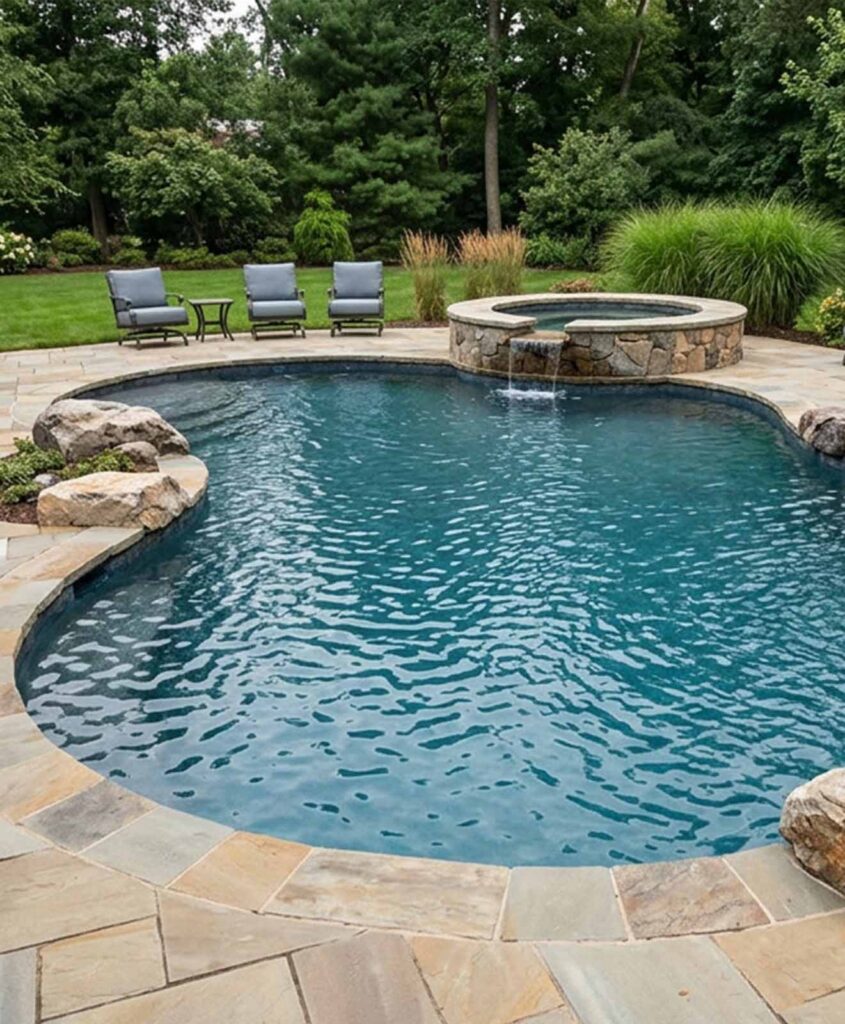
Gunite vs. Shotcrete Pools: What’s the Difference?
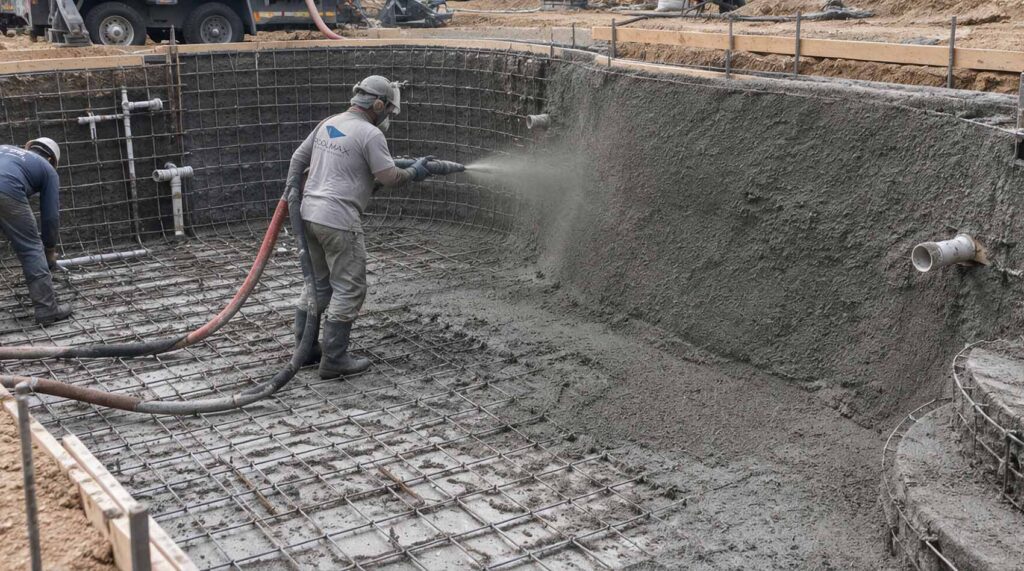
When planning a custom concrete pool, you may hear the terms gunite and shotcrete used as if they mean different kinds of pools. The main difference is actually how the concrete mixture is prepared and delivered. Both methods pneumatically project concrete at high velocity onto a prepared surface, such as a pool’s reinforced steel framework.
Gunite vs. Shotcrete at a Glance
| Feature | Gunite (Dry-Mix Shotcrete) | Wet-Mix Shotcrete |
|---|---|---|
| When water is added | At or near the nozzle | Before the mix enters the hose |
| How material travels | Dry ingredients travel through the hose | Pre-mixed concrete is pumped through the hose |
| Nozzle operator’s role | Controls water addition during application | Applies the already mixed material; air is introduced at the nozzle |
| Technical terminology | Commonly used name for dry-mix shotcrete | A type of shotcrete |
| What matters for pool quality | Mix, application, preparation, placement, and curing | Mix, application, preparation, placement, and curing |
The terms can be confusing because shotcrete is the broader term, while gunite is commonly used for dry-mix shotcrete. In other words, a gunite pool is a type of shotcrete pool; the terms do not describe two entirely different pool structures.
How the Two Methods Work
Dry-mix shotcrete, or gunite
The dry ingredients are blended and fed into specialized delivery equipment. Compressed air carries the mixture through a hose to the nozzle, where water is added before the material is projected onto the pool structure. Because water is introduced during application, the nozzle operator’s control is an important part of the process.
Wet-mix shotcrete
The concrete ingredients, including water, are mixed before delivery. A pump moves the mixture through a hose, and compressed air is introduced at the nozzle to project the material onto the receiving surface.
Is Gunite Better Than Shotcrete?
Neither method is automatically better for every pool. Gunite and wet-mix shotcrete are two ways to apply shotcrete; the right choice depends on the project, the specified mix, the site, and the capabilities and practices of the construction team. A method’s name alone does not tell you how well a particular pool will be built.
Pool-shell quality depends on more than whether the process is dry-mix or wet-mix. Preparation of the receiving surface, proper placement around the reinforcing steel, application technique, and curing all contribute to the finished work.
What Homeowners Should Ask Their Pool Builder
When comparing pool proposals, ask questions about the specified construction and quality-control process, not just the label “gunite” or “shotcrete.”
- Which application method is specified for my project—dry-mix or wet-mix?Gunite is commonly used to refer to dry-mix shotcrete, while shotcrete can refer to either process.
- What do the structural plans specify for the pool shell? The plans and project specifications—not a general marketing description—should guide the work.
- Who performs the application, and how is the work supervised? Ask how the crew handles preparation, placement, and quality checks.
- How will the material be properly cured? Curing helps maintain conditions that allow cementitious material to develop its intended properties.
- What is included in the proposal? Review the construction scope and specifications so you can understand what work is covered.
The Bottom Line
Gunite usually means dry-mix shotcrete. Shotcrete is the broader term for concrete projected at high velocity, and it includes both dry-mix and wet-mix application. For a homeowner, the most useful comparison is not simply “gunite or shotcrete,” but which method and specifications are proposed for the project—and how the builder manages preparation, placement, and curing.
Planning a Custom Pool?
PoolMax designs and builds custom in-ground pools and outdoor living spaces. Contact our team to discuss your backyard, explore design options, and review the construction scope for your project.
PoolMax — We build the outdoors. You create the memories.
Call (949) 945-7774 · CSLB #945308
Frequently Asked Questions
Are gunite and shotcrete the same thing?
Not exactly. Shotcrete is the broad term for concrete projected at high velocity. Gunite commonly refers to the dry-mix shotcrete process, where water is added at or near the nozzle.
Is a gunite pool a different kind of pool from a shotcrete pool?
The terms are often used to distinguish the application process, not two fundamentally different pool structures. A gunite pool is commonly a pool built using dry-mix shotcrete.
Which method is right for my pool?
There is no universal answer based on the term alone. The project’s design and specifications, site conditions, and the construction team’s application practices all matter. Ask your builder which method is proposed and how the work will be prepared, placed, and cured.
Does the gunite or shotcrete process affect the pool’s shape?
Shotcrete is pneumatically applied to a prepared surface, allowing it to form the pool shell according to the project design. The pool’s shape and structural requirements should be established by the project plans and specifications.